

Management reporting
“Why did that file take 45 days?” — with an answer you can defend.
Turn times by stage, which stage is costing the days, and which files are on pace to miss their date — plus the part most reporting gets wrong: telling a real change in the process from ordinary week-to-week noise, so the team chases the first and ignores the second.
Before the date
Files at risk, flagged while they can still be saved.
Each open file is judged against how long its remaining stages really take at your shop — the range of outcomes for loans like it — not against a calendar alone. Purchases likely to miss their closing date and refinances likely to outrun their lock are counted and listed, days ahead.

Signal, not noise
Control charts for every stage.
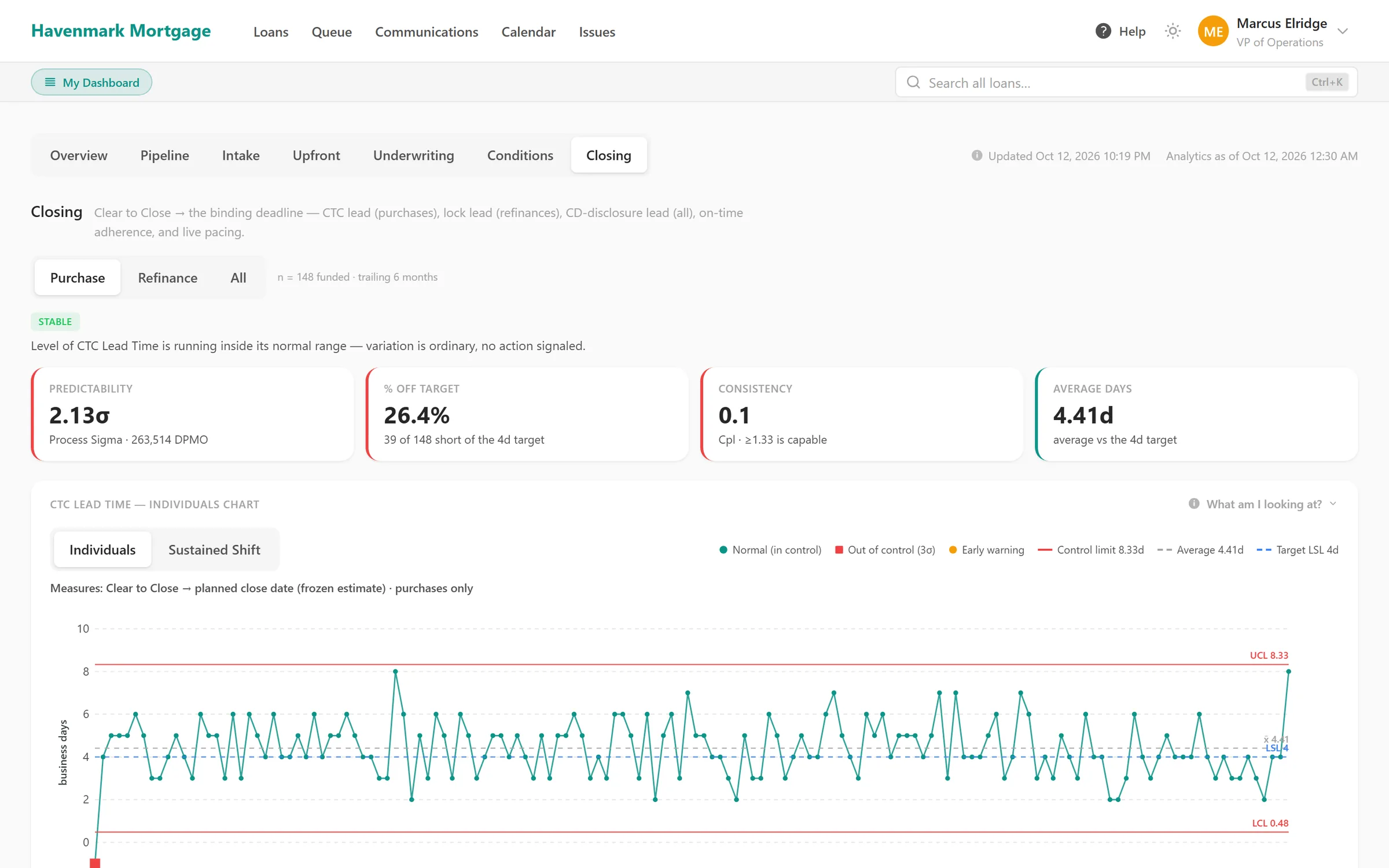
Intake, upfront, underwriting, conditions, closing: each stage gets a control chart of its turn times, how often it beats your target, and how consistently. A plain-language verdict sits on top — stable, early warning, sustained shift — so nobody has to read the chart to know whether to act.
What’s in it
The whole pipeline, one stage at a time.
Overview
The month’s funded volume, pull-through, total cycle time and on-time closings, each compared with the same point last month — and the signals that need a decision.
Pipeline and workload
What is in progress now, how long files have waited, and the load on each processor — with anyone carrying noticeably more than the rest flagged.
Stage by stage
Intake, upfront, underwriting, conditions and closing, each with its turn time against your target, its trend, and how the people who do it compare.
Purchase and refinance apart
Every section splits purchases from refinances, because they run on different clocks — the closing date for one, the lock for the other.
Your targets
Set a target turn time per stage. The charts, the off-target share and the at-risk flags all work from it.
Delegated depth
Delegated lenders get first-pass underwriting turn times, how often first passes are suspended, and condition turn-around — the underwriting half of the story.
Questions
About management reporting
Where do the numbers come from?
From the loans themselves, as they move through your LOS — no spreadsheet to keep up. Pipeline, workload and aging are live. Process control, team performance and trends are recomputed each night, since they only move as loans close and fund.
Does the reporting work with LendingPad?
Yes. It is built from the loans LendingPad sends — their status changes, milestone dates and locks — so nobody keeps a spreadsheet of turn times. How the LendingPad integration works.
What does “in control” mean here?
Every process varies week to week. A control chart draws the range that ordinary variation stays inside, worked out from your own history. A point outside it, or a run that drifts to one side, is a real change worth investigating; everything inside is noise, and chasing it wastes the team’s time.
Can we set our own targets?
Yes. Each stage has a target turn time you set, and the charts, the “off target” share and the at-risk flags all work from it. Change a target and everything that depends on it follows.
Who can see the management view?
Managers and admins by default. Like every permission in NinthOar, it can be given to another role or to one person.
Keep going
The rest of the day, covered.
Needs Attention
Locks about to expire, disclosures due, closings on hold and credit about to lapse — with a name on each — before anyone has to ask.
Learn moreClosings
A closing calendar the whole team works from, with each closing’s checklist, holds that alert everyone, and a check against what changed since approval.
Learn moreCompliance training
Training and policy acknowledgments with records nobody can edit or delete — not a manager, not an admin, not us.
Learn moreEarly access
Opening to new lenders soon.
NinthOar is in daily use at a lender today. Tell us about your shop, and we’ll reach out as soon as we can take you on.